

Are you thinking of redecorating? Something to further stylise your luxury space?
A Roman mosaic floor or a Roman wall mosaic could be the perfect way of doing so.
Rome and the United Kingdom have a long shared history. Roman culture is embedded within the UK. Roman architecture and art examples are spread across places in the UK.
This blog will give you some great ideas on the type of Roman mosaic decor that may suit your UK home.

Table of Contents
What Is a Roman Mosaic?
A Roman mosaic is a decorative art piece made by joining together small tiles called ‘tesserae’. The Romans used to craft intricate depictions of important events, battle scenes and everyday life activity scenes by joining together hundreds of tesserae.
Many such Roman mosaic floors and walls are present in ancient villas and buildings built by the Romans in different parts of Britain.
Some patterns are also specific to Roman mosaic floor and other spaces like laurel wreaths, scallops, medallions and the Greek key pattern.
Geometric patterns and the Greek key style were mostly used to decorate floor and ceiling borders. Full floors were decorated with medallion mosaics in the center with other patterning in the surroundings. The combination of black and white colours were common in geometric mosaics.
Roman mosaics for ceilings and walls were generally full murals displaying scenes with Roman figures or mythological gods and monsters.
MEC Artworks has created several Roman mosaics for a variety of spaces and customers all over the globe.
1. Roman Mosaic Floor With a Greek Key Border
A favourite choice in UK homes, the Roman mosaic floor with a Greek key border can show timelessness, elegance and modernity all at the same time.
Often such floors have a separate central pattern like a winding floral mosaic with outstretching branches that have flowers and leaves. Such floors may have a thin simple black and white Greek key border so that the mosaic does not look too busy or stuffed.
Mostly suitable for foyer areas of luxury homes or crafted in stone in patios.
Sometimes full mythological scenes depicting gods and monsters from ancient Roman lore may be crafted in tesserae on the floor just like one may see in a painting. Framing this fantastic scene is an elegant Greek key border which is often kept in simple colours as a lot of colour and activity has already been crafted in the central area.
Medallion mosaics can be crafted in the center of the floor with a light coloured surrounding mosaic to make the Medallion the focal point. A Greek key mosaic border may then be added around the light shaded surroundings to complete the artwork.
Complicated central patterns may also be framed with a simple Greek key border, also known as the Meander pattern. Ancient examples of such mosaics crafted for pavements have been unearthed in Southern Turkey.
This style of the Roman mosaic floor with Greek key borders has been modernised for UK homes. Colour palettes may vary depending on the rest of the interior. However, they are very popular in the black and white combination.
They give a sleek look to the decor of the whole house when crafted in hallways at the entrance of the home.
2. Roman Mosaic Rug and Floor Medallion
Roman mosaic floor rugs and medallions are another gorgeous Roman style mosaic design for modern UK homes.
Floor medallions may vary in size depending on the area of the floor that needs covering and the taste of the client. Medallion mosaics are mostly circular but may be oval or polygon shaped.
A medallion may be large with various concentric design patterns or may have one large central design with small motifs scattered around the central design. For smaller-sized floors, like narrow entrance lobbies, relatively smaller medallions may be crafted with one kind of imagery or geometric pattern.
Care must be taken to select a design pattern and colour palette that gels with the rest of the interior. Like for a very large flower motif which is to cover most of the space in a large-sized medallion may be a good idea on a big floor where more space is to be covered. In smaller spaces they will make the floor look messy and give the space an overfull look.
Mosaic rugs seem to be taking over from the regular fabric rugs. Roman mosaic rugs mostly feature floral patterns or geometric designs. The Greek key pattern appears in many Roman style mosaic rugs.
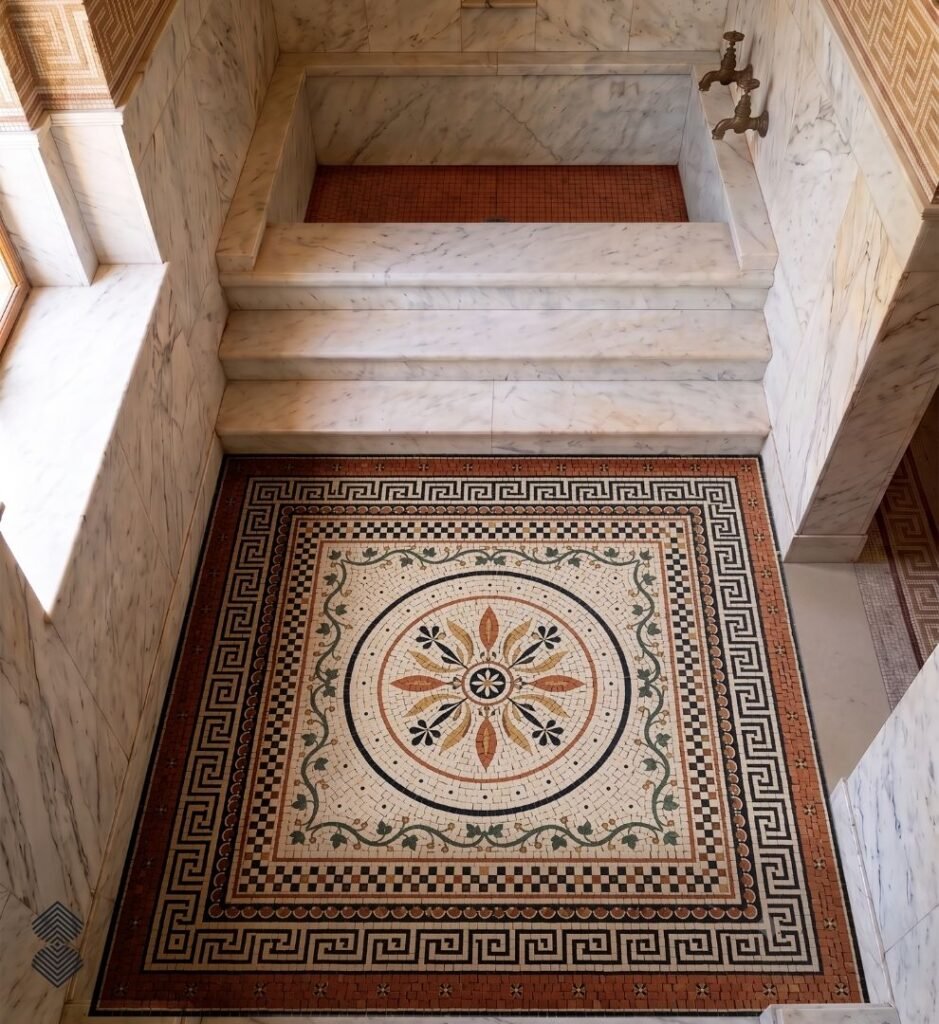
Roman mosaic floor rugs may be used to demarcate a sitting space at the entrance of a house. They can also be used in place of carpets in living rooms and parlours. Roman mosaic floor rugs can be crafted in entrance hallway too
They are a great idea for wet areas like bathroom floors too. Where fabric rugs may get wet and create maintenance problems, mosaic rugs may be swept dry quite easily.
3. Fish Mosaic Floor
Are you a marine-life lover?
Then the Roman-inspired fish mosaic floor would be just up your street as an option for mosaic floor decor.
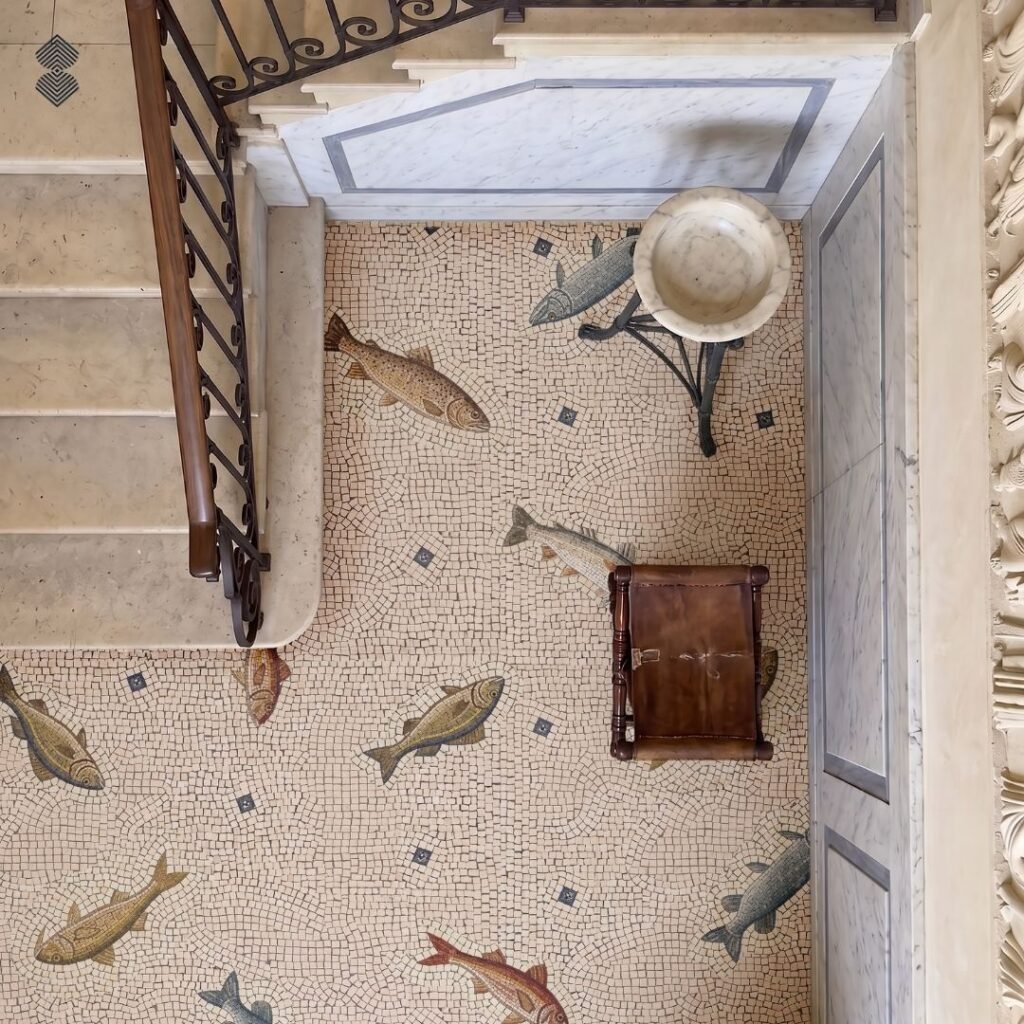
Fish mosaic floors were crafted in ancient Rome in luxury homes, courtyards, dining areas and public bath floors. The fish were crafted with brightly coloured tiles. Textured mosaics were crafted in which all the features of the fish like fins, scales and gills were made prominent.
Modern fish mosaic floors are crafted in glass for modern UK home. Contemporary homes use iridescent glass tiles in different bright colours for a dramatic effect. Fish mosaics may be crafted on bathroom floors, staircase landings and on pool floors too.
Another modern touch added to fish mosaic floors is the creation of an abstract backdrop for the fish motifs in shades of blue and turquoise instead of creating proper waves to depict water. This makes the Roman mosaic art more interesting by leaving some interpretation of the mosaic to the viewer’s imagination.
4. Roman Unswept Floor Mosaic
For those who like something a little different from the ordinary.
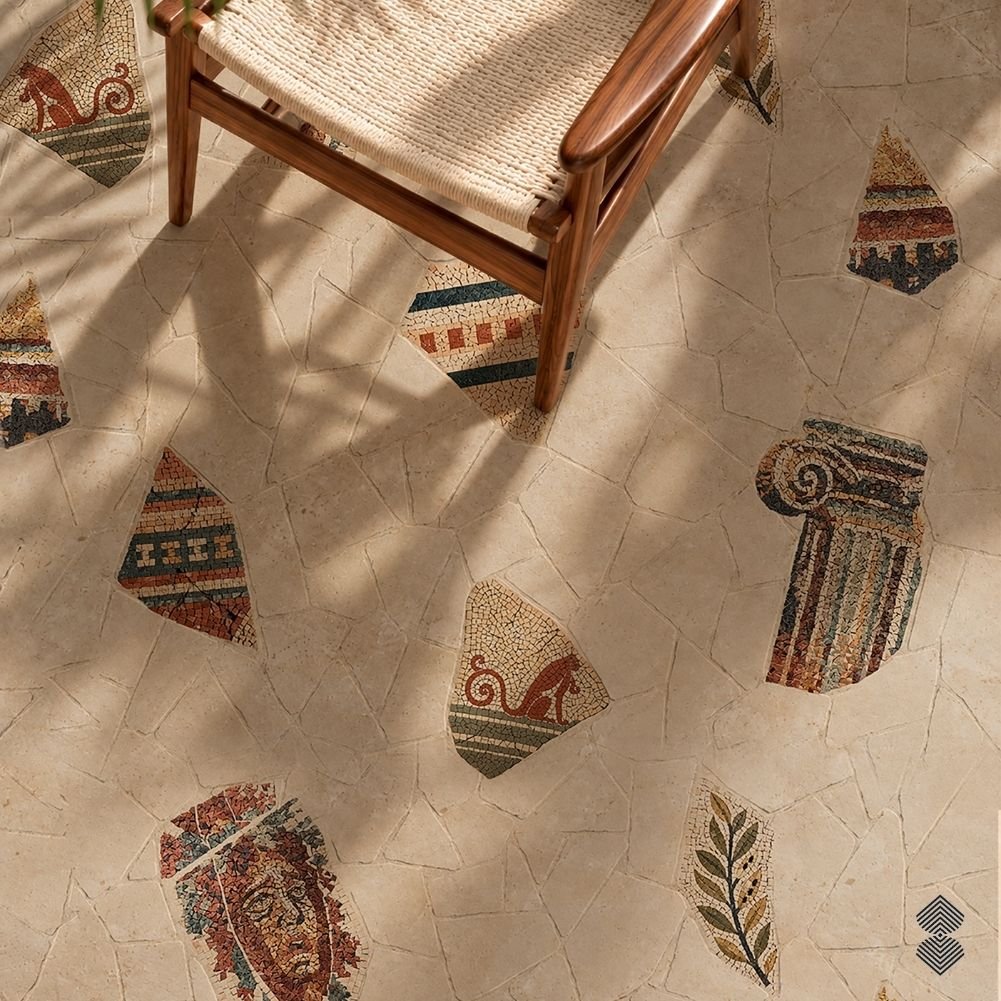
The unswept floor mosaic was a playful creation by a celebrated mosaic artist in ancient Greece. Instead of the traditional flowers, animal motifs and geometric patterns, he went for something different.
The idea originated in the form of a mosaic pattern which showed an unswept floor after a grand banquet with leftovers thrown on the ground. Fish bones, apple cores, grape pips, crumbs of bread, bones from meat and mice or other small animals shown eating those leftovers.
The idea was adapted by Roman mosaic makers and became a part of their tradition. This mosaic was often crafted in dining rooms of luxury houses as lighthearted humour that guests at a party could enjoy.
The unswept floor mosaic idea has evolved from that time. The leftovers on the ‘unswept’ floor are adapted according to the room they are being crafted in.
For kitchen floors it could be half-eaten sandwiches and fruit, empty bottles of juice or water, vegetable peels, etc. For bathroom floors shells, sea-life and marine plants can be depicted.
The background for the unswept floor mosaic is often light colours like beige, ivory and warm whites so that the ‘leftovers’ are more visible in contrast.
The unswept floor’s modern adaptations leave much to the client or mosaic designer’s imagination. The ‘leftovers’ can be anything from half-finished pizza to socks thrown on the ground.
View an unswept floor mosaic crafted by MEC Artworks that shows pieces of pottery, a plant stalk and other whimsical items requested by our client.
5. Scallop Mosaic Feature Wall
We have provided you with several gorgeous suggestions for Roman mosaic floors.
Now let’s talk about some exciting wall mosaics, shall we?
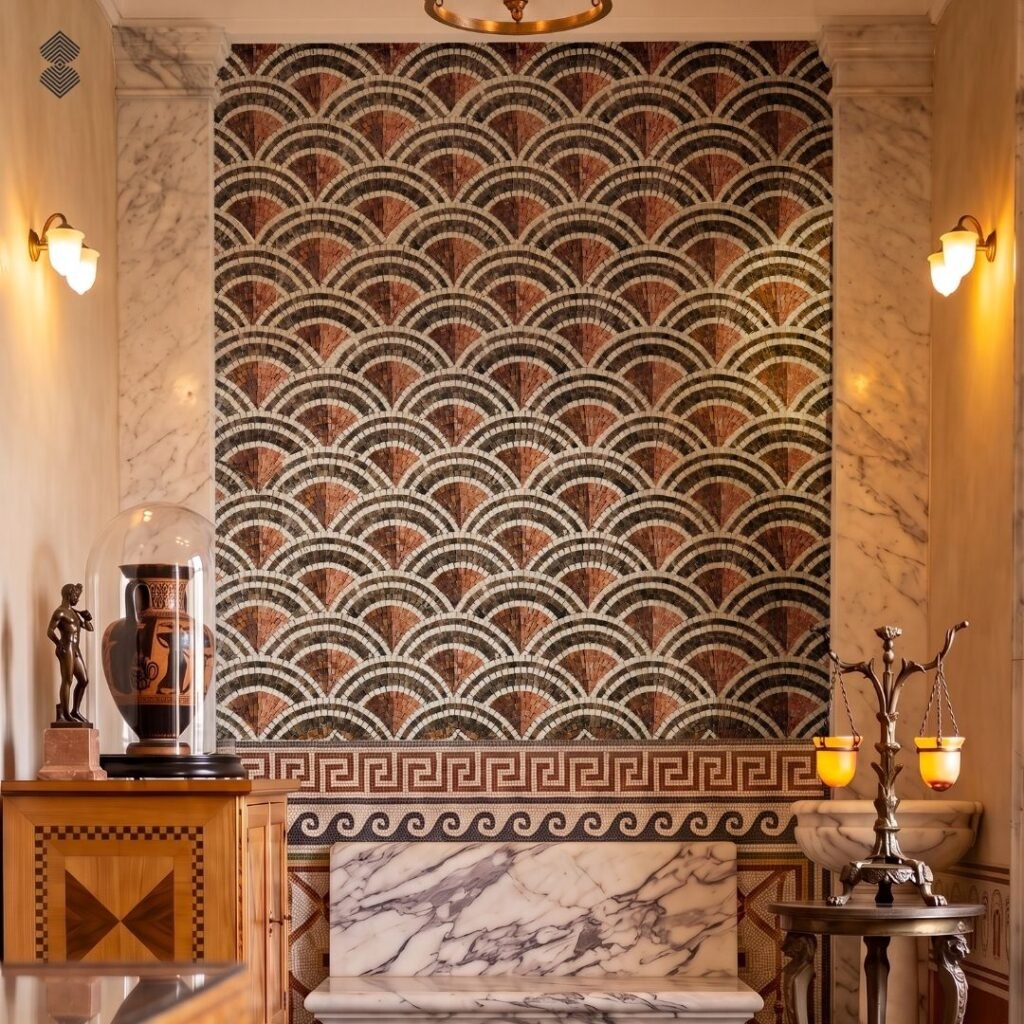
Scallop design mosaics sit on the intersection of geometric and nature-inspired mosaics. While the scallops may be seen as semi-circles and classified as geometric mosaics, they may also be seen as patterns made by waves as they rise and crash and the design found on the skin of several types of fish.
Scallop mosaic walls may be crafted as backsplashes in kitchens and bathrooms. Their orderly design pattern brings a certain calm and orderliness in its surroundings too.
A great choice for spaces where one aims to give a stylish but neat look. Scallop mosaic walls are trending in British interiors. The curvature of scallops also gives a softness to the often linear furniture and cabinets in a space.
Contemporary interiors use the following materials for crafting scallop mosaic feature walls
- Glass
- Marble
- Porcelain
- Mother of pearl
The destined area will decide what material may be used in a particular project. If the mosaic is for the kitchen or bathroom then glass or marble may be the best choice as they are easy to clean and maintain.
For a living room feature wall, more luxurious materials like Mother of pearl may be used too.
6. Fish and Wave Mosaic Wall
How about we add some fish to those waves?
A combination of two of the Roman mosaic floor and wall designs discussed above. This mosaic style gives a client the choice to create a combination of their favourite fish designs with waves style that will suit their existing interiors.
The feature wall may be requested in the exact shape and size that will fit into a certain space.
Fish and wave mosaic walls are mostly commissioned for kitchen and bathroom walls in UK homes. Glass may be used when a brighter style is required. Glass can also incorporate many colours. Kitchen wall backsplashes may be designed as the focal point of the kitchen.
Colours that complement and elevate the elegance of the kitchen decor may be used to create fish and wave mosaics in the kitchen. For bathrooms, often other sea-life is also added to such mosaics including starfish, sea plants and coral, etc.
In this way more colours and style can be added to the mosaic. General hues may be selected according to the fixtures in the bathroom.
7. Roman Garden Wall Mural
A great way of creating an outdoors environment indoors!
Instead of Roman mosaic floor ideas, walls are a better option for Roman garden murals.
Roman garden wall murals show beautiful garden scenes with some or all of the following items:
- Garden plants
- Flowers
- Birds and butterflies
- Fountains
- Specific examples of Roman architecture like columns, pillars, arches and Roman style buildings
These murals were created on large main walls. As there was a lot to be displayed, these mosaics often covered entire walls.
Roman garden murals are mostly commissioned for living room and parlour walls in luxury homes in the UK. Often for a classical feel they are crafted in pastel shades mostly. As they are large in size and consist of lots of hues they command the entire decor of the room they are installed in.
Roman garden murals can be created on garden, courtyards and patio walls too.
A beautiful way of connecting your luxury space to ancient grandeur. A way to visit an ancient luxury Roman villa.
The most appropriate material for indoor Roman garden murals is glass. For outdoor garden murals, natural stone and marble are better options.
8. Mosaic Border Tiles for Walls, Arches and Doorways
A great idea for homeowners who may not want entire surfaces covered with mosaic art.
Many Roman-inspired mosaic design tiles are available for walls, arches and doorway borders. The most famous and forever popular design is the Greek key design. It may be crafted with sharp linear lines or soft curves as desired by a client.
The rope border pattern is a signature Roman style mosaic design. It consists of tesserae set to look like a length of braided rope placed along the border of a doorway or other architectural feature.
Other Roman-inspired border options include
- Geometrical patterns like repetitive shapes
- Organic patterns like Laurel leaves, repeating wreaths and flowing vines
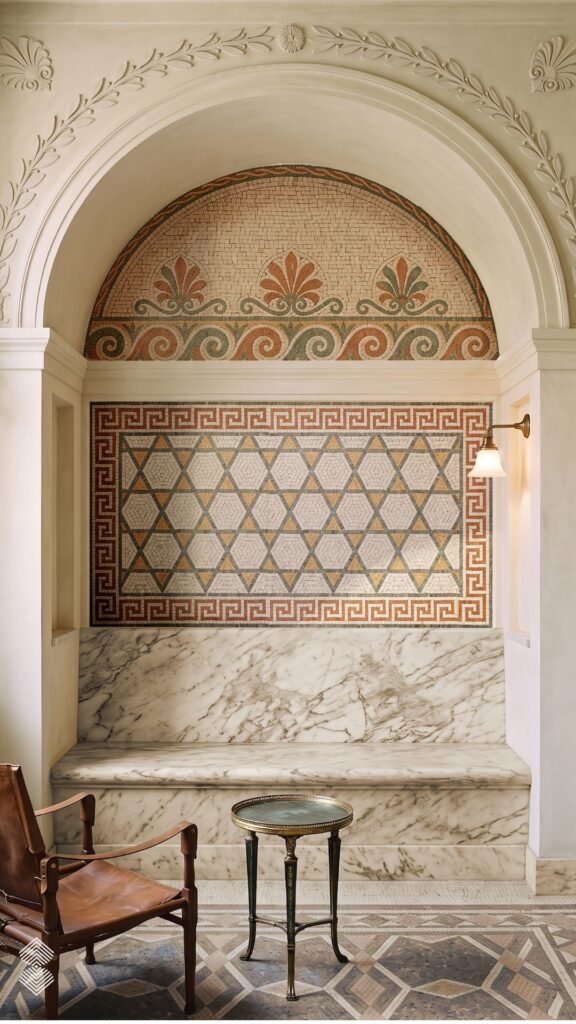
9. Mosaic Arch and Wall Panels
Arches were a very common architectural feature in Roman houses. It was only natural to decorate these arches.
Mosaic arches were also decorated with mosaic art. Often the entrance of houses had doors set in arches. Mosaic arches set a grand first impression of a house. The same technique is being used in modern and classical interiors in the UK.
UK homes may have entrance arches decorated with geometric mosaic patterns, floral mosaic art, abstract compositions and mythological scenes containing Roman gods and medallion mosaics.
Wall panel mosaics are crafted when entire walls cannot be dedicated to mosaic art like when the space is small or is already decorated and small changes are required.
Panel mosaics can be on top of the wall’s surface or in wall niches specially carved for them.
Panel mosaics can be crafted for bathrooms in shower niches or behind bathtubs or vanities. In living rooms they look perfect above fireplace enclosures or in a dedicated section of a large wall. Panel mosaics may also be created for hallways where they can be used to decorate a section of the wall.
This is a good idea when the hall way is narrow and a full Roman mosaic floor or wall might make it look too busy or crowded.
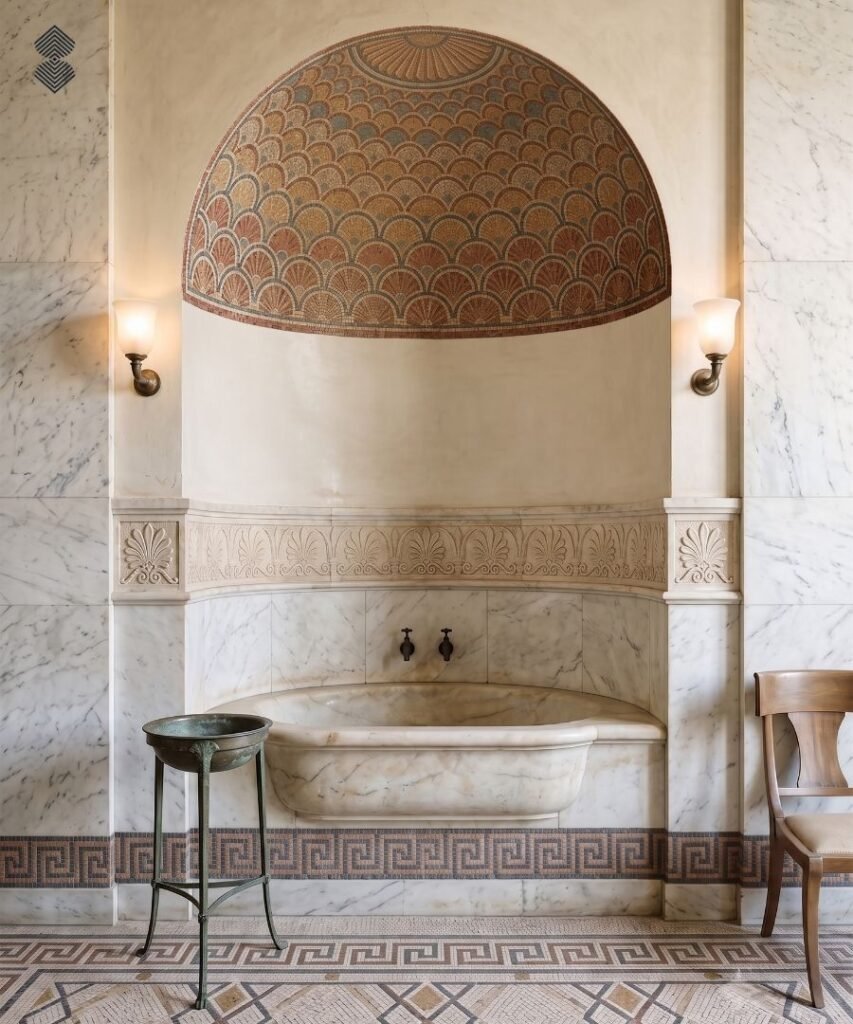
10. Roman Style Bathroom With a Mosaic Shower Niche
Roman style bathrooms sport marble columns, Roman floor mosaic rugs and backsplashes, decorative Roman mosaic panels and mosaic key or some signature Roman style mosaic bordering.
The colours are generally warm and neutral ones, like whites, beige, warm grey and muted gold. Some dark colours are used for contrast like terracotta and charcoal.
Roman style bathrooms are inspired by the public baths in ancient Rome where mostly structures were built in marble and natural stone. Modern Roman bathrooms mosaic also use marble as the main material. Marble with natural veining in browns gives a very earthy and organic feel to the mosaic artwork.
Shower niches are little cavities made in the shower area of the bathroom. They usually hold bathroom supplies or may be purely decorative. They may be linear or arched.
Roman style mosaic art is a popular way of decorating these shower niches. Marble is the perfect material for these mosaics. Greek key borders, floral motifs, laurel leaves with flowing vines and other geometric patterns are some design patterns for such shower niches.
In the mood for your very own Roman mosaic floor or wall art? Contact us today and together, let’s decide what kind of Roman mosaic will look best in your space.
Frequently Asked Questions
What were Roman mosaics made of?
Roman mosaics were primarily made from small pieces called tesserae, crafted from natural materials such as marble, limestone, coloured stones, pebbles and terracotta. Glass and ceramic were also used to introduce brighter colours and finer details, particularly in decorative wall mosaics and intricate designs. These small pieces were carefully arranged and set into mortar to create geometric patterns, floral designs, mythological scenes and everyday imagery.
How were Roman mosaics made?
Roman mosaics were created by skilled artisans who arranged tiny pieces called tesserae to form intricate designs and images. First, they prepared the surface with several layers of mortar to create a firm base. They then placed small pieces of marble, stone, glass or ceramic into the wet mortar, following a planned pattern or picture. After the mortar dried, the surface was cleaned and finished. This careful process produced durable mosaics depicting geometric patterns, animals, plants, mythological figures and scenes from everyday Roman life.
Can a Roman mosaic go in a shower or wet room?
Yes, a Roman-inspired mosaic can be used in a shower or wet room, provided the materials and installation are suitable for constant moisture. Glass, porcelain and certain types of marble are popular choices, while the surface should have an appropriate slip-resistant finish for shower floors. Proper waterproofing, suitable grout and professional installation are essential to prevent water penetration and staining. Geometric patterns, Greek Key borders and classical motifs can also add a distinctive Roman touch to shower walls and niches.
How do you clean a marble mosaic floor?
Clean a marble mosaic floor using a soft mop or microfibre cloth and a pH-neutral stone cleaner mixed with water. Avoid acidic products such as vinegar, lemon juice and harsh chemical cleaners, as they can etch or dull the marble surface. Use a soft brush to remove dirt from grout lines, and wipe up spills promptly to prevent staining. Rinse with clean water if required by the cleaner’s instructions and dry the floor with a soft cloth to avoid water marks. Regular gentle cleaning and periodic professional sealing can help preserve the marble’s natural finish and keep the mosaic looking beautiful.